
What is iGaming and is it legal under US federal law?
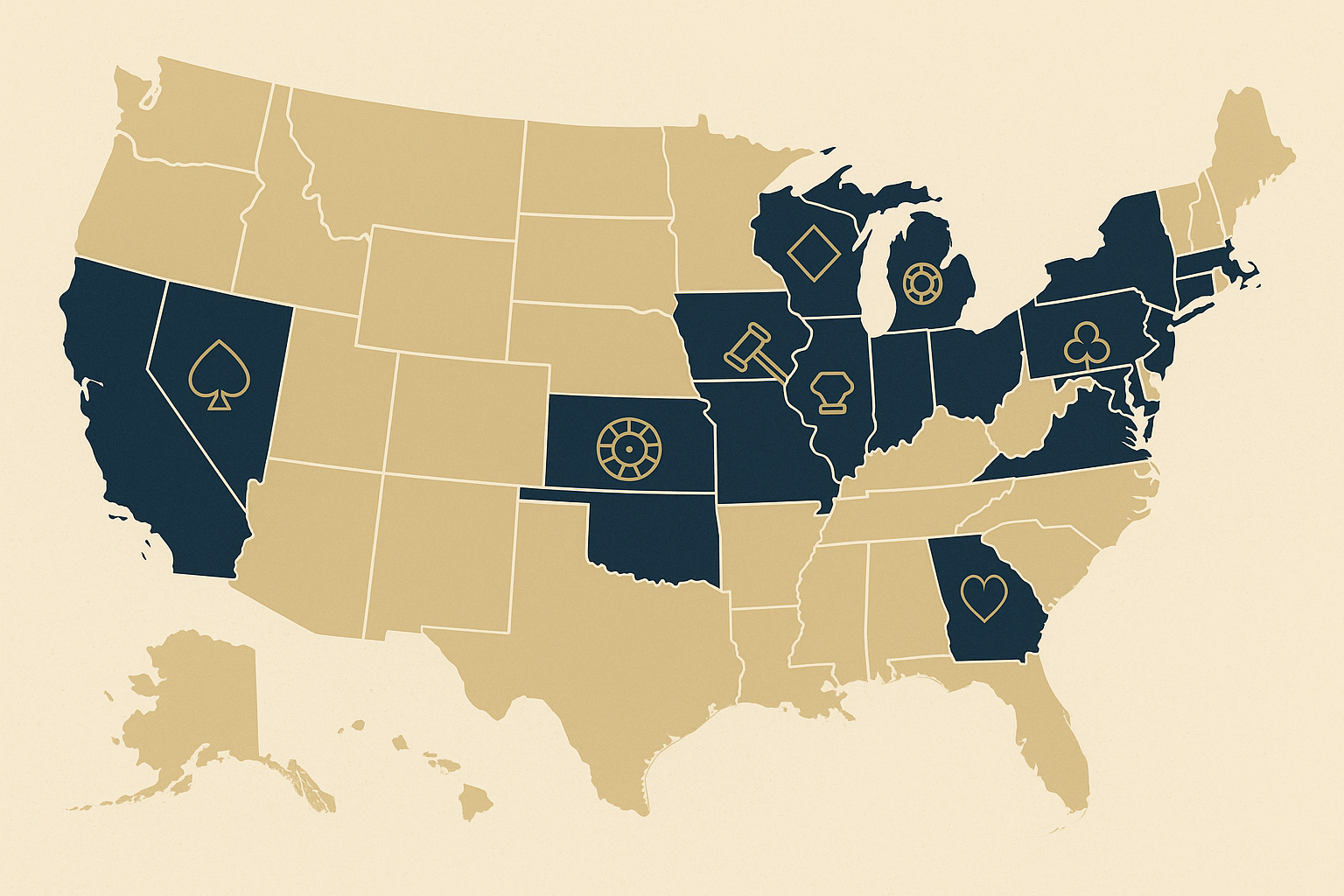
Yes, iGaming is legal in the US, but only in a handful of states that have passed their own laws to authorise and license it. As of 2025, seven states have legal real-money online casino gaming: New Jersey, Delaware, Pennsylvania, West Virginia, Michigan, Connecticut and Rhode Island. Nevada allows online poker only. Everywhere else, no licensed online casino exists.
“iGaming” in the American regulatory sense means internet casino gaming: slots, blackjack, roulette, baccarat, video poker, live dealer tables and online poker, played for real money through a state-licensed platform. It does not include sports betting, daily fantasy sports, online lottery ticket sales or horse racing wagering. Those sit in separate legal buckets with separate rules, which is exactly why so many people get confused. You can legally bet on an NFL game in dozens of states and still have no legal way to spin a slot online in the same state.
At the federal level, three laws matter most:
- The Wire Act (1961) bars the use of interstate wire communications to transmit certain wagers. A 2011 Department of Justice opinion read it as covering sports betting only; the DOJ reversed itself in 2018; then in 2021 the First Circuit Court of Appeals ruled in the New Hampshire Lottery Commission case that the statute applies to sports wagering, not other forms of gambling. The DOJ did not take that ruling to the Supreme Court, and no federal enforcement action has been brought against a state-licensed online casino.
- UIGEA (2006) targets payment processing for internet gambling that is unlawful under other state or federal law. It creates no new prohibition of its own and contains carve-outs for intrastate transactions conducted under state law, which is the legal plumbing that lets banks process deposits in regulated states.
- IGRA (1988) governs tribal gaming and shapes how states such as Connecticut and Michigan structured their online markets around tribal compacts.
The practical upshot: Congress has never legalised or banned online casino gaming nationally. It has left the decision to the states, and most states have simply not acted. This article is general information, not legal advice.
iGaming legal states in 2025
Seven states run regulated online casino markets. Each requires players to be at least 21 and physically located inside state lines while playing, verified by geolocation software. You do not have to be a resident, but you do have to be there.
| State | Online casino launched | Regulator | Market structure |
|---|---|---|---|
| New Jersey | November 2013 | Division of Gaming Enforcement | Open, casino-tethered licences |
| Delaware | November 2013 | Delaware Lottery | Lottery-run, single platform provider |
| Pennsylvania | July 2019 | Pennsylvania Gaming Control Board | Open, casino-tethered licences |
| West Virginia | July 2020 | West Virginia Lottery | Casino-tethered licences |
| Michigan | January 2021 | Michigan Gaming Control Board | Commercial and tribal partners |
| Connecticut | October 2021 | Department of Consumer Protection | Limited: two tribal operators plus lottery |
| Rhode Island | March 2024 | Rhode Island Lottery | Single operator (Bally’s) |
New Jersey: the pioneer state
New Jersey signed its internet gaming law in February 2013 and went live that November, becoming the template everyone else copied. Online operators must partner with an Atlantic City casino licence holder, servers sit in state, and the Division of Gaming Enforcement publishes monthly revenue reports and a list of authorised sites. New Jersey also has the deepest game library in the country, including a competitive online poker market.
Pennsylvania and Michigan: the major markets
Pennsylvania authorised iGaming in Act 42 of 2017 and launched online casinos in July 2019 under the Pennsylvania Gaming Control Board. Each of the state’s land-based casinos could buy certificates for slots, table games and poker, which produced a crowded, competitive market.
Michigan passed the Lawful Internet Gaming Act in December 2019 and launched in January 2021. Its structure is unusual because commercial Detroit casinos and federally recognised tribes both hold licences, so tribal operators compete statewide alongside the Detroit three. The Michigan Gaming Control Board licenses platforms, suppliers and occupational staff, and publishes an authorised operator list.
Other regulated states
- Delaware launched alongside New Jersey in 2013 and runs everything through the Delaware Lottery and its three racinos. It is the smallest legal market by a wide margin.
- West Virginia passed the Lottery Interactive Wagering Act in March 2019 and saw its first online casino go live in July 2020, tied to the state’s five casino licensees.
- Connecticut legalised in 2021 through amended tribal compacts. Only two casino brands operate, one partnered with the Mohegan Tribe and one with the Mashantucket Pequot Tribal Nation, plus the Connecticut Lottery for online lottery products.
- Rhode Island became the seventh state in March 2024, with a single operator running online casino games under the Rhode Island Lottery.
- Nevada is the outlier: online poker is legal and regulated, but online slots and table games are not.
Nevada, Delaware, New Jersey and Michigan share online poker player pools under the Multi-State Internet Gaming Agreement, which is the only meaningful interstate liquidity arrangement in US iGaming.
How iGaming differs from sports betting legally
More than 35 states plus Washington, D.C. offer legal sports betting. Only seven allow online casino games. The gap is not an accident.
Sports betting expanded fast because of one court decision. In Murphy v. NCAA (2018), the Supreme Court struck down PASPA, the 1992 federal law that had frozen sports wagering outside Nevada. That removed a single federal barrier for every state at once, and legislatures moved quickly with a product voters understood and pro leagues had stopped fighting.
Online casino gaming never had a PASPA. It has always been a purely state-level question, so there was no unlocking moment and no wave. Several other factors slow it down:
- Cannibalisation fears. Land-based casino operators and their unions often argue online slots pull revenue and jobs away from brick-and-mortar floors, while sports betting was framed as a new customer acquisition tool.
- Political optics. Legislators find “bet on the game from your couch” easier to sell than “play slots on your phone at 3am,” and problem gambling groups scrutinise online casino products harder because play is continuous and fast.
- Tribal exclusivity. In many states, compacts give tribes exclusive rights to Class III casino games. Extending those games to the internet means renegotiating compacts, which is slower and riskier than adding a sportsbook.
- Constitutional hurdles. Some states, Maryland among them, would need a voter referendum to authorise online casino gaming, not just a bill.
The federal picture also differs in tone. The Wire Act’s text and the 2021 First Circuit ruling put sports wagering squarely inside its scope, so licensed sportsbooks are careful to keep bets intrastate; interstate online poker liquidity, by contrast, operates under the reading that the Wire Act does not reach non-sports gambling. That distinction is legal, not commercial, and it explains why casino games can pool players across state lines while sports bets cannot.
States considering iGaming regulation
Bills appear every session, and most die. A realistic read of the current landscape:
- New York has seen repeated internet gaming bills, most prominently from Senator Joseph Addabbo Jr., who chairs the Senate committee overseeing gaming. None has passed both chambers, and iGaming has been left out of enacted state budgets so far.
- Illinois legislators have introduced an Internet Gaming Act in multiple sessions to license online casino operators through existing casino licence holders. It has not advanced to a floor vote.
- Indiana has studied iGaming and heard bills in committee, with lawmakers repeatedly returning to the topic without passing a law.
- Maryland came closest of the recent contenders: the House of Delegates passed an internet gaming measure in 2024, but it did not clear the Senate, and any authorisation there would likely go to voters.
- Ohio, Virginia, Massachusetts and Wyoming have all had introduced bills or formal study discussions at various points.
Treat any “coming soon” claim with suspicion until a bill is signed and a regulator publishes rules and licence holders. Legalisation and launch are usually 9 to 18 months apart, as the Pennsylvania and Michigan timelines show.
How to verify iGaming legality in your state
Go to the primary source, not a marketing page. Every regulated state publishes a list of licensed sites, and if a brand is not on that list, it is not legal there.
- Find your state’s regulator. Search the official state domain (.gov) for the gaming commission, control board, division of gaming enforcement or lottery. Examples: the Michigan Gaming Control Board and the Pennsylvania Gaming Control Board. New Jersey’s Division of Gaming Enforcement, the West Virginia and Delaware lotteries, Connecticut’s Department of Consumer Protection and the Rhode Island Lottery perform the same role in their states.
- Check the authorised operator list. Licensed casinos display their licence number and regulator logo in the site footer. Cross-check it against the regulator’s own list.
- Test the geolocation gate. A legal US casino app will refuse to accept wagers if you are outside state borders. A site that happily takes your money from a state with no legal market is telling you what it is.
- Confirm the age rule. Every regulated online casino state requires players to be 21 or older, and full KYC identity verification before withdrawal. Sites that skip ID checks are not regulated in the US.
Offshore casinos and crypto sites that accept US players are not licensed by any US regulator. Practically, that means no dispute resolution if a payout is refused, no audited RNG or RTP verification, no enforced deposit limits or self-exclusion, and no guarantee your funds are segregated. Depending on your state’s laws, playing on them may also expose you to liability. The same caution applies to sweepstakes-style casino sites, which operate under a different legal theory and have drawn cease-and-desist activity and new restrictions in several states.
FAQ
Is iGaming considered gambling under US law?
Yes. Online casino games involve consideration, chance and a prize, which is the standard legal test for gambling in most states. That is why they require a state licence, 21+ age verification and KYC checks, and why winnings are reportable income for federal tax purposes.
Which states allow online casinos?
New Jersey, Delaware, Pennsylvania, West Virginia, Michigan, Connecticut and Rhode Island allow full online casino gaming. Nevada permits regulated online poker only.
Can I play from another state if I have an account?
No. Accounts are state-specific and geolocation blocks wagering outside the licensed state, even if you registered while you were there. Interstate play is permitted only for shared online poker pools under the Multi-State Internet Gaming Agreement.
Is online sports betting legal in more states than iGaming?
Considerably more. Sports betting is live in more than 35 states plus Washington, D.C., largely because the Supreme Court’s 2018 Murphy decision removed a federal ban that only ever applied to sports wagering.
Play within your limits
Every casino game carries a built-in house edge, meaning the operator keeps a percentage of all wagers over the long run and players lose money over time on average. Legal status has nothing to do with your odds. If gambling stops being entertainment, use the deposit, loss and session limits and self-exclusion tools every licensed US site is required to offer, review our responsible gambling guide, or contact the 1-800-GAMBLER helpline or the National Council on Problem Gambling. Online casino gaming in the US is restricted to players aged 21 and over.