
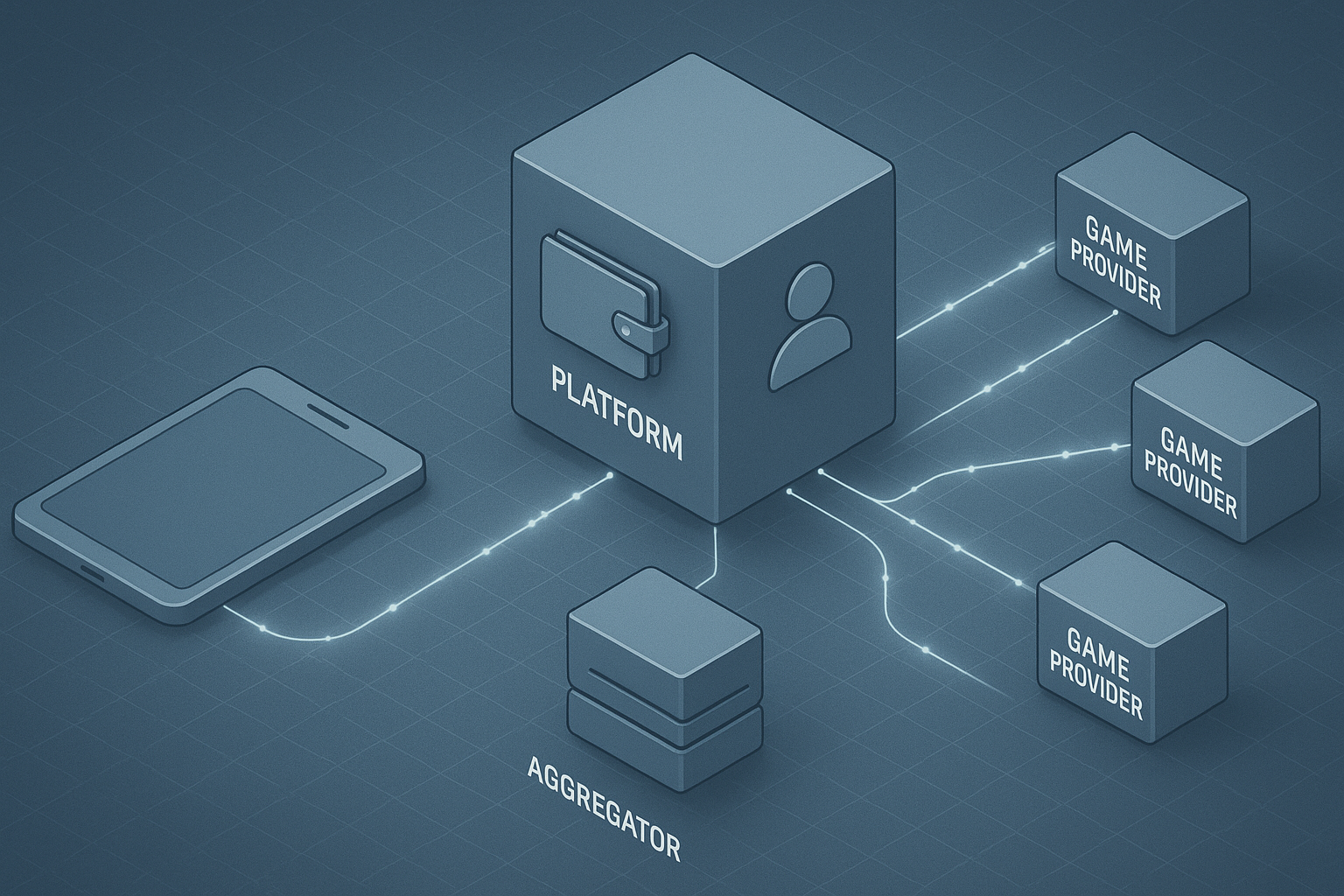
An online casino you see in a browser is the thin front end of a supply chain with at least three distinct layers: the iGaming platform that runs accounts, wallets and compliance; the providers that build the actual games; and often an aggregator sitting between them. Almost no operator builds all of that in-house. Understanding who does what is the fastest way to make sense of the industry, whether you’re evaluating a site as a player or pricing out a business as a prospective operator.
What is an iGaming platform?
An iGaming platform is the back-end software that runs a real money gambling site: player registration, wallets, bonuses, reporting, payment routing, and the rules that keep all of it inside a regulator’s requirements. The games are content that plugs into it. The platform is the plumbing.
Most platforms are sold B2B, which is why the same core system can sit behind a dozen different-looking casino brands. Core functions usually include:
- Player account management (registration, login, KYC status, self-exclusion flags)
- A single wallet that tracks balance across slots, live dealer tables and sportsbook
- Payment processing integrations with card acquirers, bank transfer rails and e-wallets
- Bonus engine: deposit matches, free spins, wagering requirement tracking, game weighting
- CRM and reporting, plus regulatory data feeds and audit logs
- Responsible gaming tools: deposit and loss limits, session timers, reality checks, cool-off
That bundle is often called a casino management system. Buy it as a hosted service under your own licence and it’s a turnkey platform; run your brand on someone else’s licence and infrastructure and it’s a white label, which is cheaper to launch and gives you far less control.
Platform vs provider vs aggregator: key differences
These three terms get used interchangeably in marketing copy, and they shouldn’t be. Here’s the honest split:
| Layer | What it does | Who its customer is | Examples |
|---|---|---|---|
| Platform | Runs accounts, wallet, bonuses, payments, compliance reporting | The operator (casino brand) | Playtech, EveryMatrix, SoftSwiss, GAN |
| Game provider (studio) | Designs and hosts the games; owns the maths and RNG | Operators and aggregators | Evolution, Pragmatic Play, Play’n GO, Light & Wonder |
| Aggregator | Bundles many providers behind one API and one contract | Operators and platforms | Pariplay, Slotegrator, SoftSwiss Game Aggregator, Oryx (Bragg) |
Some companies occupy more than one row. Playtech sells a platform, builds its own games and distributes third-party content. Evolution is a provider that also owns studios it acquired, including NetEnt and Red Tiger. Treat the categories as functions, not as fixed corporate identities.
The role of iGaming providers and software companies
An iGaming provider is a game studio. It designs the game, writes the maths model, sets the theoretical RTP, gets the game certified by an independent test lab, and then hosts it on its own servers. When you spin a slot, the outcome is usually calculated on the provider’s infrastructure, not the casino’s, and the game window itself is served from the provider’s domain inside an iframe.
That matters more than it sounds. It means the casino you deposited with generally cannot change a game’s RTP or results at will. What operators can sometimes choose is which certified RTP version of a title to license, since some studios ship the same slot in multiple configurations (for example 96.5% and 94%). Two casinos can therefore run the “same” game at different house edges, which is one of the few things worth actively checking in a game’s info screen.
Major iGaming providers
Provider specialisms split fairly cleanly by content type:
| Content type | What it covers | Well-known suppliers |
|---|---|---|
| Slots / RNG games | Video slots, instant win, RNG table games | Pragmatic Play, Play’n GO, NetEnt, Games Global, Light & Wonder, IGT |
| Live dealer | Streamed roulette, blackjack, baccarat, game shows | Evolution, Playtech Live, Pragmatic Play Live |
| Sportsbook | Odds feeds, bet engine, trading and risk tools | Kambi, Betgenius (Genius Sports), Sportradar, SBTech (Light & Wonder) |
| Crash and “provably fair” games | Multiplier games with cryptographic verification | Spribe, Turbo Games and similar studios |
Live dealer is a different business from slots because it’s capital intensive: real studios, real croupiers, camera rigs, optical character recognition on the wheel, and a video stream that has to hold up on mobile data. That’s why so few companies do it at scale.
How provider integration works
A direct provider integration is a commercial and technical project, not a plug-in. The operator signs a content agreement (typically revenue share), completes the provider’s due diligence, then connects to a wallet API so the game can ask “does this player have funds?”, debit a bet, and credit a win back to the platform balance. Add certification for each regulated market, currency and language configuration, and reporting reconciliation, and a single direct integration can take weeks of developer time.
Multiply that by 60 studios and you have the problem aggregators exist to solve.
Game aggregators: the middlemen of iGaming
A game aggregator is a distributor that has already integrated dozens of providers and exposes all of them through one API, one contract and one reporting dashboard. The operator connects once and gets access to thousands of titles, with new studios added by the aggregator rather than by the operator’s own developers.
Examples include Pariplay’s Fusion, Slotegrator’s APIgrator, the SoftSwiss Game Aggregator, Oryx from Bragg Gaming, and EveryMatrix’s casino content offering. Several platform vendors also bundle aggregation into their core product, which is why the lines blur.
The trade-offs are straightforward. In favour: speed to market, one integration and one invoice, easier switching of content, plus tools like unified free spin campaigns and jackpots across studios. Against: another party taking a slice of revenue, less direct commercial leverage with the top studios, and one more dependency in the chain if the aggregator has downtime. Larger operators often run a hybrid, integrating the biggest names directly and using an aggregator for the long tail.
The technology stack: RNG, APIs, and fair play
Underneath the commercial layers, iGaming technology comes down to two questions: is the outcome genuinely random, and did the money move correctly?
Random number generation (RNG)
An RNG is the algorithm that produces each round’s result. Certified casino RNGs are pseudo-random generators seeded so that outputs are statistically unpredictable and, critically, independent: the previous spin has no influence on the next one. There is no such thing as a machine warming up or going cold, and no bet pattern changes the odds.
Independent test houses such as GLI, BMM Testlabs, eCOGRA and iTech Labs audit RNG output and verify that a game’s actual return matches its stated theoretical RTP. RTP is a long-run average over millions of rounds, and its inverse is the house edge: a 96% RTP slot carries a 4% edge, which is exactly why the operator profits over time and why no strategy overcomes it. Volatility describes how those returns are distributed, not how much comes back.
Crash-style games added a different approach: provably fair. The round’s result is derived from a server seed and a client seed, with the hashed server seed published in advance, so a player can verify afterwards that the outcome wasn’t altered mid-round. It proves the round wasn’t tampered with. It does not remove the house edge.
For a deeper walkthrough of certification and how to read an RTP figure, see our guide to RNG and game fairness.
API integration and data flow
Everything above talks to everything else over APIs. The platform holds the single wallet and is the source of truth on balance. The provider holds the game logic. Each bet is a transaction with a unique ID, so if a connection drops mid-spin the two sides can reconcile rather than double-charging or losing a win. Alongside that sit payment provider APIs, KYC and identity verification services, geolocation checks and regulator reporting feeds.
Licensing and compliance layer
Compliance isn’t a department bolted on at the end; large parts of it are coded into the platform. A licensed operator has to verify identity and age, block prohibited jurisdictions, monitor for money laundering patterns, log every transaction for audit, and expose responsible gaming controls that actually work at the wallet level.
Who enforces this depends on the market. In Europe, the Malta Gaming Authority and the UK Gambling Commission are the reference points. In the United States, there is no federal online casino licence: regulation is state by state, through bodies like the New Jersey Division of Gaming Enforcement, the Pennsylvania Gaming Control Board and the Michigan Gaming Control Board. Online casino games are legal in only a small number of states, while online sports betting is far more widely permitted. Every game and every platform release generally needs approval in each state separately, which is why a title live in New Jersey may be missing in Michigan.
US-facing operators also use geolocation technology (GeoComply is the best known supplier) to confirm a player is physically inside state lines before a bet is accepted.
Regulated platforms are required to give players real control: deposit, loss and session limits, cool-off periods and self-exclusion. If you gamble, set those limits before you need them, and treat the money as entertainment spend that you expect not to get back. Support in the US is available through the National Council on Problem Gambling and the 1-800-GAMBLER helpline. Our responsible gambling resource covers the tools in more detail.
How it all works together: from game to player
Here’s the full path a single spin takes through the iGaming software chain:
- You log in. The platform authenticates the account, checks KYC and self-exclusion status, and confirms your location and jurisdiction.
- You open a game. The platform (or aggregator) requests a game session and receives a launch URL with a one-time token.
- The game loads in an iframe served from the provider’s infrastructure, in demo or real money mode.
- You press spin. The game calls the wallet API through the aggregator to debit the stake; the platform confirms funds and returns an authorised transaction.
- The provider’s certified RNG generates the outcome and the game engine maps it to symbols and any win amount.
- Any win is credited back through the same API to your platform balance, and the animation you watch is just the presentation of a result already decided.
- The transaction is logged on both sides, feeds bonus wagering counters, and lands in the reports the operator files with its regulator.
The whole loop takes a fraction of a second and touches three or four separate companies. That’s the useful takeaway: when a game freezes, a balance looks wrong, or a title vanishes from a lobby, the cause is usually a handoff between these layers rather than anything the casino brand did in the moment. And no layer in that chain changes the underlying maths, which is fixed, certified, and always tilted toward the house.
FAQ
What does an iGaming provider do?
It builds and hosts the games. A provider owns the maths model and RNG, submits each title for independent certification, and serves the game to players through an API the operator’s platform connects to.
What software runs online casinos?
A casino management platform (from vendors such as Playtech, EveryMatrix, SoftSwiss or GAN) handles accounts, wallet, bonuses, payments and compliance, while game content comes from separate provider studios, usually delivered via an aggregator.
How do game aggregators work?
An aggregator pre-integrates many providers and exposes them through a single API and contract, so an operator connects once and gets thousands of games instead of negotiating and building dozens of separate integrations.