Quick answer: the key differences
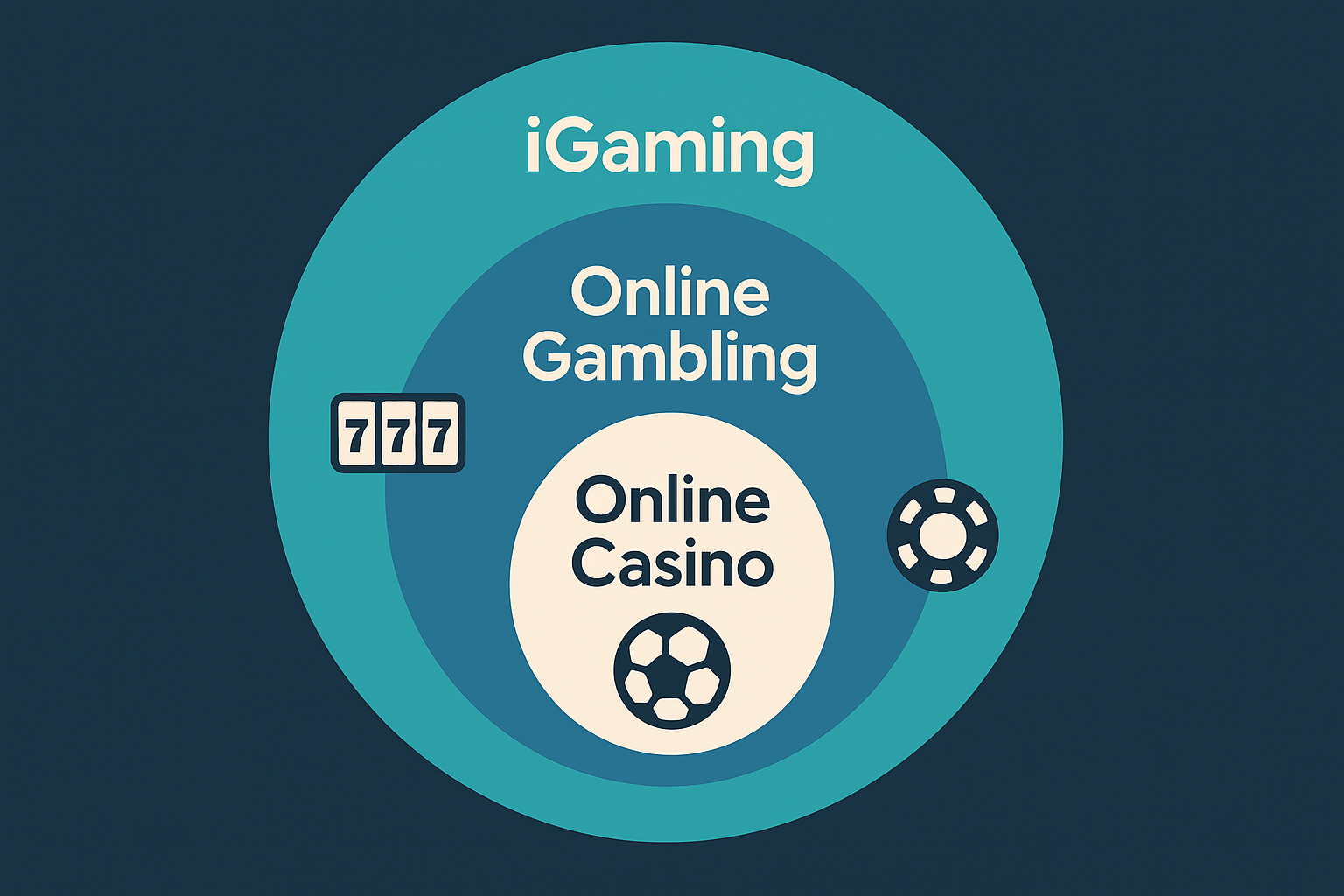
Is iGaming gambling? Yes, in practice it is, but the words work at different levels. iGaming is the industry label for the whole business of real-money gaming delivered over the internet. Online gambling is the activity itself, betting money on an uncertain outcome through a website or app. An online casino is one type of platform inside that industry, the kind that offers slots, table games and live dealer games.
So all three describe the same world from different angles: industry, action, venue. If you picture nested circles, iGaming is the outer ring, online gambling is what happens inside it, and an online casino is one specific room in the building.
What is iGaming?
The iGaming meaning most people in the business use: any form of real-money gaming played over the internet, plus the companies, software and regulation around it. It covers operators, game studios, payment providers, affiliates and regulators, not just the sites you log into.
What sits under the iGaming umbrella:
- Online casinos (slots, blackjack, roulette, baccarat, live dealer tables)
- Online sportsbooks and in-play betting
- Online poker rooms and tournaments
- Online bingo and lottery-style games
- Daily fantasy sports and esports betting, depending on the jurisdiction
- Crash games and other newer digital formats
You will also see regulators and older documents use different words for the same thing. The UK’s Gambling Act 2005 talks about “remote gambling”. Several US state statutes say “internet gaming” or “interactive gaming”. Marketing teams say “digital gaming”. They are all pointing at the same category, and “iGaming” simply won as the shorthand the industry adopted.
One wrinkle worth knowing: in US industry conversation, “iGaming” is often used more narrowly to mean online casino only, with sports betting spoken about separately as “sports wagering”. A press release saying “the state launched iGaming in 2021” usually means online slots and table games went live, not sportsbooks. Globally, the term is broader. Context decides.
What is online gambling?
Online gambling is the act of staking money on a game or event with a random or uncertain outcome, using an internet-connected device. That’s the whole definition. It describes what a person does, not what a company is.
The iGaming vs gambling difference is mostly one of register. “Gambling” is the plain, legal and consumer-facing word. It appears in statutes, in problem gambling research, in helpline names and in the phrase “responsible gambling”. “iGaming” is the professional, slightly softer term the industry uses about itself, and you’ll see it in job titles, trade shows and investor decks far more often than in a state law.
Three elements usually have to be present for something to count as gambling: you risk something of value, the outcome depends at least partly on chance, and there’s a prize. That’s why a free-to-play social slots app generally isn’t gambling, while the same game with real money staked is. It’s also why the legal treatment of poker and daily fantasy sports gets argued over, since both involve real skill alongside chance.
Every real-money format shares one mathematical trait: a house edge. If a slot has a 96% return to player (RTP), the house edge is 4%, meaning the game is built to keep about $4 of every $100 wagered over the long run. RTP is a long-run average across millions of rounds, not a promise about your session. Outcomes are produced by a random number generator, so past spins tell you nothing about the next one.
What is an online casino?
An online casino is a specific type of iGaming platform focused on casino games. Think of it as the digital equivalent of a casino floor rather than a sportsbook counter.
A typical online casino lobby contains:
- Slots, including Megaways and cluster-pays titles, each with a published RTP and volatility profile
- Table games such as blackjack, roulette, baccarat and casino poker variants, run by RNG software
- Live dealer games, streamed in real time with a human dealer at a physical table
- Game shows and instant games, plus video poker and scratch-style titles
Where the online casino vs iGaming line falls: the casino is one product vertical, iGaming is the whole market. A sportsbook is a different vertical, with different maths (odds, margin, implied probability) and usually a different licence category. A poker room is a third, because players bet against each other and the operator takes rake instead of holding a house edge on each hand.
In practice, many US operators now bundle these under one account. You might deposit once and move between a sportsbook tab and a casino tab in the same app. That convenience is exactly why the terms blur for readers, and it’s why knowing which product you’re in matters when you read the terms of a bonus.
How these terms overlap and differ
Here’s the distinction in one view.
| Term | What it is | Includes | Excludes | Typical use |
|---|---|---|---|---|
| iGaming | The industry and its verticals | Online casinos, sportsbooks, poker, bingo, lottery, game studios, suppliers | Land-based-only venues; free social games with no real-money stake | Trade press, job ads, investor and regulatory reports |
| Online gambling | The activity of wagering online | Any real-money bet placed over the internet, on any product | The companies and technology behind it; playing for free | Laws, consumer guides, responsible gambling resources |
| Online casino | One platform type within iGaming | Slots, blackjack, roulette, baccarat, live dealer, game shows | Sports betting, peer-to-peer poker rake models, retail casino floors | Player-facing sites, game reviews, state licensing categories |
Read the table as scope, activity, venue. An online casino is always iGaming. iGaming is not always an online casino. And playing at an online casino is always online gambling, whichever label the operator prefers.
Where sports betting fits in
Sports betting is part of iGaming when it happens online, but it is not part of an online casino. Same industry, different product.
The mechanics differ in ways that matter to a bettor. Casino games run on fixed probabilities you can calculate in advance: European roulette has 37 pockets, so a single-number bet pays 35 to 1 against odds of 36 to 1, producing a 2.70% house edge on every spin. A sportsbook instead prices an event it cannot fully predict and builds a margin into the odds. Decimal odds of 2.00 imply a 50% chance; when both sides of a coin-flip market are priced below that fair value, the difference is the overround.
For US readers, the split is also legal. The Supreme Court’s 2018 decision in Murphy v. NCAA struck down the federal law that had confined most sports betting to Nevada, and states moved quickly. Online sports betting is now live in a large majority of states. Online casino gaming, by contrast, has been authorised in only a handful, including New Jersey, Pennsylvania and Michigan, and each state licenses it separately. So “iGaming expanding in the US” can mean two very different things depending on which vertical the writer had in mind. Editor’s note: verify current state-by-state status against the American Gaming Association’s tracker before publication.
Why these distinctions matter
They matter because the words map onto different rules and different products.
- Legality is per vertical, per state. Your state allowing online sportsbooks tells you nothing about whether online slots are legal there. Check the specific licence, and check that the operator appears on your state regulator’s list.
- Bonus terms follow the product. A casino welcome offer carries a wagering requirement, often something like 30x the bonus, with game weighting that makes slots clear faster than blackjack. Sportsbook promos usually work through odds thresholds and bonus bets instead. Reading the wrong set of terms is how players get surprised.
- Search results reflect the term you use. Search “iGaming” and you’ll mostly get trade news, conferences and jobs. Search “online casino” and you’ll get player-facing sites and reviews. If you want consumer information, use the consumer word.
- Job hunting and research. Newcomers looking for work in the field should search iGaming, gaming or wagering, since almost no employer advertises for a “gambling marketer”.
Whatever the label, the underlying maths doesn’t change: every real-money product carries a house edge or a margin, and over time it favours the operator. Treat any stake as money spent on entertainment, set deposit and time limits before you play, and use cool-off or self-exclusion tools if play stops feeling like a choice. In the US, the National Council on Problem Gambling helpline (1-800-GAMBLER) is free and confidential. This content is for readers of legal gambling age in their jurisdiction.
FAQ
Is iGaming the same as online gambling?
Nearly, but not exactly. Online gambling is the activity of wagering real money over the internet. iGaming is the industry term for that whole sector, including the operators, game studios and suppliers behind it. Anything you’d call online gambling happens within iGaming, and iGaming without real money at stake isn’t gambling at all.
What is the difference between an online casino and iGaming?
An online casino is one vertical inside iGaming, the one offering slots, table games and live dealer games. iGaming also covers sportsbooks, poker rooms, bingo and online lottery. Every online casino is an iGaming business; not every iGaming business is an online casino.
Does iGaming include sports betting?
Internationally, yes: online sports betting is one of the main iGaming verticals. In US industry usage, though, “iGaming” is often shorthand for online casino specifically, with sports betting referred to as sports wagering, and the two are licensed under separate state frameworks. Check which sense a source means.