
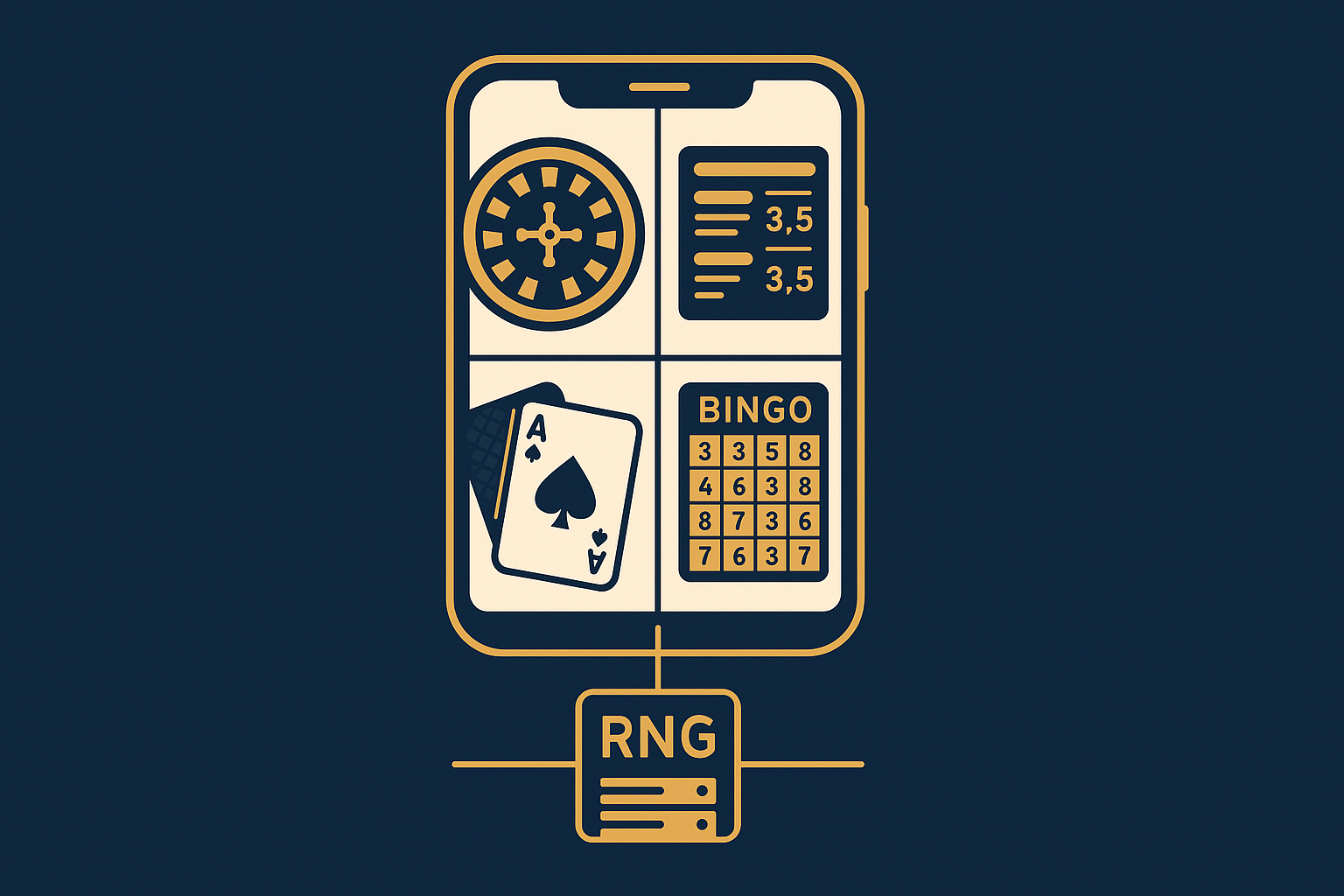
What is iGaming? (definition and scope)
iGaming is gambling that happens online, where players wager real money on games or events through a website or app instead of a physical venue. That’s the whole definition. The “i” is just shorthand for internet, the same way “email” once needed the “e”.
So yes, iGaming is gambling. The industry adopted the term because it sounds cleaner in a boardroom, not because it describes something fundamentally different. If real money is at stake on an uncertain outcome, it’s gambling, whether you’re feeding a bill into a slot machine in Atlantic City or spinning the same game on your phone in your kitchen.
What actually changes online is everything around the wager:
- Where the randomness comes from. A land-based roulette wheel is physical. An online roulette game uses a certified random number generator, or a live video feed of a real dealer spinning a real wheel.
- Scale and choice. A casino floor fits a few hundred slot machines. A regulated online casino can list two or three thousand titles, because shelf space costs nothing.
- Stake sizes. Online games routinely accept 10 or 20 cent spins, which is below what most physical floors bother with.
- Data and account controls. Every bet is logged against a verified identity, which is why deposit limits, loss limits and self-exclusion tools exist online in a way they can’t on a cash floor.
- Verification. You can walk into a casino with cash and ID. Online, you complete KYC (Know Your Customer) checks and geolocation before you can play.
One term worth separating out: iGaming is not the same as “gaming” in the video game sense. Esports, mobile games and free-to-play apps are not iGaming unless real-money wagering is involved. Some people also use “iGaming” narrowly to mean online casino only, treating sports betting as a separate category. In this guide it covers the full set of real-money online verticals, which is how most regulators and operators use it.
Main types of iGaming products
Four product categories cover almost everything you’ll encounter. Here’s what each one actually looks like from the player’s side.
| Type | What you’re betting on | Typical examples |
|---|---|---|
| Online casino | RNG or live dealer game outcomes | Slots, blackjack, roulette, baccarat, game shows |
| Sports betting | Results of real sporting events | NFL point spreads, NBA player props, live in-play bets |
| Online poker | Other players, not the house | Texas Hold’em cash games, sit-and-gos, tournaments |
| Bingo and lottery | Drawn numbers | 90-ball bingo rooms, online Powerball ticket sales, instant-win games |
Online casinos
The biggest slice of the market by game count. Slots dominate, usually a few thousand titles from dozens of studios, each with a published RTP (return to player) figure. Most fall in the 94% to 97% range, meaning the game returns roughly $94 to $97 per $100 wagered averaged over millions of spins. The remainder is the house edge, and it applies over the long run, not to your session.
Alongside slots you get digital table games and live dealer tables, where a real croupier deals from a studio and you bet through an overlay on the video stream. Live blackjack and live roulette are the anchors there. The house edge on a single-zero European roulette wheel is 2.7%; the American double-zero version is 5.26%, and plenty of online lobbies carry both, so the version you pick matters.
Sports betting
An online sportsbook prices markets on real events and lets you back them. In the US that means moneylines, point spreads, totals, parlays and a huge menu of player props. Two features are specific to the online version: live in-play betting, with prices updating during the game, and cash-out, which lets you settle a bet early at a price the book offers. The book’s edge is baked into the prices as the margin, or overround, which is why two roughly even outcomes are typically priced near -110 rather than +100.
Online poker
Poker is the odd one out because you’re playing other people, not the operator. The site takes a cut, called the rake, from each pot or as a tournament entry fee. Online play is faster than live, you can play multiple tables at once, and stakes start at pennies. In the US, poker liquidity is limited by state borders, which is why some states share player pools through interstate agreements and others keep them separate.
Bingo and lottery
Online bingo rooms run scheduled games with chat, and cards are usually marked automatically. Lottery online splits into two things worth distinguishing: official state lottery sites that sell real tickets or instant-win games, and third-party “lottery betting” products where you wager on the outcome of a draw without holding a ticket. Availability of either depends entirely on your state.
How iGaming technology works
Four pieces sit behind every real-money bet you place: a random number generator, a platform, game providers, and payment processing. You never see any of them, but each one affects whether the game is fair and whether you get paid.
Random number generators (RNG)
An RNG is the software that decides each outcome, and it’s the digital replacement for a shuffled deck or a spun wheel. Every spin, deal or roll is generated independently, so previous results have no influence on the next one. There is no such thing as a machine that’s “due” or a slot that’s gone cold; that belief, the gambler’s fallacy, is the single most expensive misunderstanding in online casino play.
In regulated markets, RNGs don’t just get taken on trust. Independent testing labs examine the algorithm and run statistical tests on millions of simulated outcomes, and regulators require certification before a game goes live. They also verify that the game’s actual return matches its advertised RTP. Some crypto-focused sites additionally offer provably fair systems, where cryptographic seeds and hashes let you check after the fact that a specific round wasn’t tampered with.
Gaming platforms and providers
The brand you sign up with is rarely the company that built the games. A typical setup looks like this:
- The operator holds the licence, owns the brand, handles your account and pays your withdrawals.
- The platform is the underlying software running accounts, wallets, bonuses, reporting and regulatory compliance. Some operators build their own; many license one.
- Game providers are the studios that make the slots and run the live dealer studios. A single lobby might pull titles from twenty or more of them via aggregators that bundle content into one integration.
- Payment processors move money in and out, through debit cards, bank transfers, PayPal, prepaid play+ cards or cash at a casino cage.
Two more layers are specific to regulated US markets. Geolocation software confirms you’re physically inside a state where the product is licensed, usually via a browser plug-in or app permissions. Identity verification confirms your age and identity before you can withdraw. Both are legal requirements, not operator preferences, and they’re why online gambling is restricted to adults of legal age in licensed states.
Is iGaming legal in the United States?
There’s no single national answer, and anyone who gives you one is oversimplifying. Legality is decided state by state, so the same app can be fully licensed in New Jersey and unavailable across the river in New York. This section is general information, not legal advice; check your own state’s regulator or gaming commission for current rules.
The federal layer sets some boundaries. The Wire Act of 1961 restricts certain interstate wire communications for betting. The Unlawful Internet Gambling Enforcement Act of 2006 targets payment processing for unlawful online gambling rather than individual players. And in 2018, the Supreme Court’s decision in Murphy v. NCAA struck down PASPA, the law that had effectively blocked most states from authorising sports betting. That ruling is why the US online betting map changed so fast after 2018.
Beyond that, states decide. The practical picture breaks down by product:
- Online sports betting: the most widely available vertical, live in a large majority of states plus Washington DC, with a handful of holdouts including California and Texas.
- Online casino: far more restricted. Only a small group of states has authorised real-money online casino play, including New Jersey, Pennsylvania, Michigan, West Virginia, Connecticut, Delaware and Rhode Island.
- Online poker: a similarly short list, largely overlapping with the online casino states plus Nevada, with some states sharing player pools across borders.
- Lottery: a number of state lotteries sell tickets or instant games online; rules differ everywhere.
This list moves. States legalise, launch dates slip, and court cases change things, so treat any snapshot, including this one, as a starting point rather than the final word. Offshore sites that accept US players without a state licence are a separate matter: they operate outside US regulatory protection, which means no certified RNG requirement you can rely on, no state regulator to complain to, and no guarantee your balance is segregated or your withdrawal honoured.
Real-world iGaming examples
The definition gets much clearer when you attach names to it. These are among the largest US-licensed operators, and each one shows how the verticals combine in practice.
- DraftKings began in daily fantasy sports and moved into sportsbook, then online casino. Its casino product runs in the handful of states that permit it, while its sportsbook covers many more.
- FanDuel followed the same path, and like DraftKings runs its sportsbook and casino as separate apps in some states because of how licensing works.
- BetMGM is the online arm tied to MGM Resorts’ land-based business, offering sportsbook, online casino and poker depending on the state, with loyalty tied back to physical properties.
- Caesars operates a sportsbook and online casino linked to its rewards programme, again with the product mix set by each state’s rules.
Notice the pattern: the same brand, the same technology stack, different products depending on which side of a state line you’re standing on. That’s the defining feature of American iGaming and the reason “is it legal?” always needs a state attached to the question.
Frequently asked questions
What does iGaming mean?
iGaming means real-money gambling conducted over the internet, covering online casino games, sports betting, poker, bingo and lottery products played through a website or app.
Is iGaming the same as gambling?
Yes. iGaming is simply the online form of gambling. The term describes the delivery channel, not a different activity, and the same house edge and risk apply.
What are the main types of iGaming?
Online casino (slots, table games, live dealer), sports betting, online poker, and bingo and lottery products. Some operators run all of them under one account; others specialise.
Is iGaming legal in the US?
It depends on your state and the specific product. Online sports betting is legal in most states; online casino and poker are limited to a small number, including New Jersey, Pennsylvania and Michigan. Always check your state regulator.
How do I know an online casino game is fair?
In a licensed market, games use RNGs tested by independent labs and certified by the state regulator, and published RTP figures are verified. That confirms the game behaves as advertised. It does not remove the house edge.
A note on playing responsibly
Every product described here carries a built-in mathematical advantage for the house or the operator. Over time, that edge means the majority of players lose money, and no strategy, system or bonus changes that. Treat any money you wager as the cost of entertainment, never as income or a way to solve a financial problem.
Licensed operators are required to offer deposit limits, loss limits, session reminders, cool-off periods and self-exclusion. Use them before you need them. If gambling is causing stress for you or someone close to you, help is available in the US through the National Council on Problem Gambling at ncpgambling.org or the national helpline on 1-800-GAMBLER. Online gambling is restricted to adults who meet their state’s legal age requirement.